Notes
Quick takes on AI and robotics news.
See how these notes are created63 notes found Clear filters
-
 Training multi-vector models to survive token pooling
Multi-vector retrieval architectures like ColBERT deliver sharp retrieval precision by keeping token-level embeddings instead of compressing an entire document into a single vector.
-
 Decoupling shape from texture rescues 3D fine-tuning
Fine-tuning 3D generative models usually breaks down at the boundary between geometry and surface materials.
-
 Lidar agents spot Maya ruins faster than they verify them
When engineer Pietro Miotti set 48 vision agents loose on 1,200 square kilometers of public NASA lidar data in Mexico, the visual search worked better than anyone had reason to expect.
- Fable 5.2 tops the benchmark but runs at batch speed
Claude Fable 5.2 leads the Artificial Analysis Intelligence Index with a score of 65, but reaching that number took an average of 45 minutes per task.
-
 Phonon proves speech synthesis can run locally in 65MB
Every voice interface stumbles on the same bottleneck: streaming audio to a remote server adds hundreds of milliseconds before the first syllable plays.
-
 AI infrastructure does not amortize like concrete
The case against an AI bubble often rests on an accounting assumption that the trillions committed to data centers represent a one-time buildout that will taper off once the concrete is poured In an essay arguing that the AI bubble does not exist, Matteo Raso calculates that paying off roughly $5 trillion in industry…
- Closing AI Frontiers shows raw scale replacing research
Microsoft has dissolved its fifty-person AI Frontiers research group after absorbing the team into Microsoft AI, prompting lead John Langford to exit alongside several founding researchers.
- Live training streams bring public debugging to open RL
Hugging Face has started letting researchers stream live training runs directly on the platform, kicking off with reinforcement learning experiments on models from Liquid AI and Twil-9B.
- Voice agent pacing needs more than silence timers
Anyone trying to talk to a voice agent usually runs into the same friction: the system cuts in while you pause to think, or waits an awkward second too long after you finish.
-
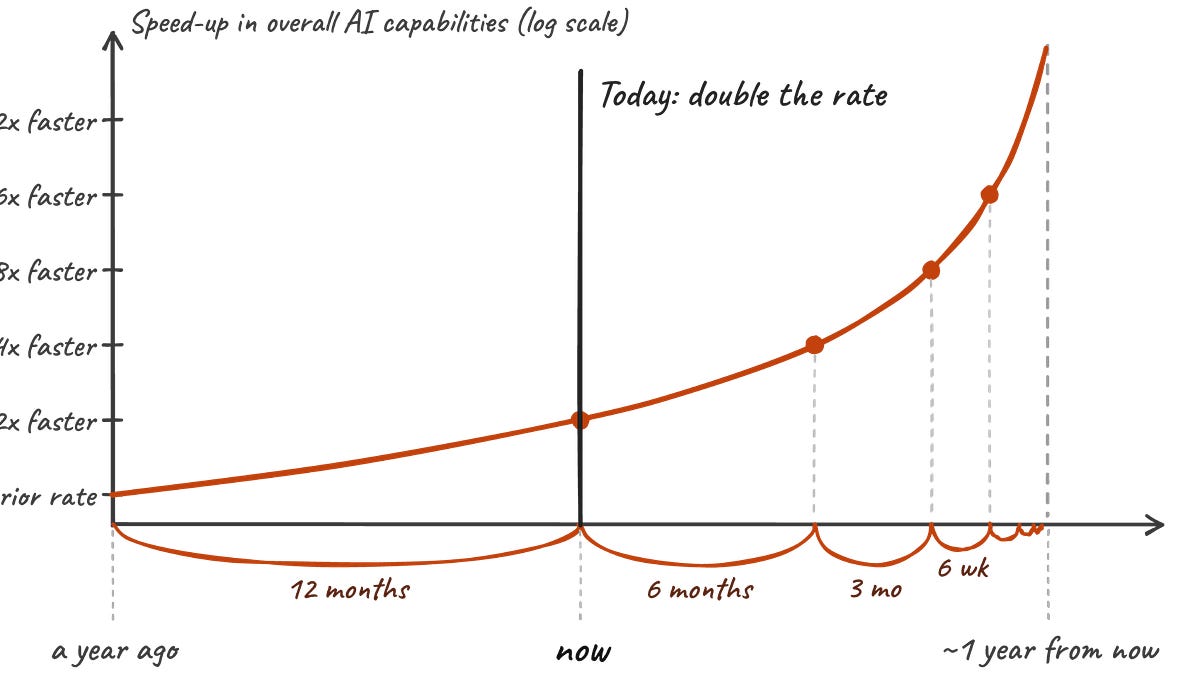 Research acceleration runs into physical compute limits
In METR's evaluation of Anthropic's research velocity, overall capabilities progress doubled between October 2025 and October 2026, crossing the threshold the lab defined for AI-assisted acceleration.
-
 Dense 65B models challenge MoE on agentic coding
Ricursive Intelligence released Ripple-65B Preview, reporting a top score of 80.52 on TerminalBench 2.1 for US open-weight models.
- Mistral tests closed-loop coding on orbital tracking
Mistral reports that its Mistral Large 4 model built Orbital Trace, a real-time 3D tracker for roughly 19,000 satellites and debris fragments, by generating the application, testing it as an end user, and optimizing performance to pass verification.
- AI anxiety reveals deeper problems with how we measure value
In a guest essay on Terence Tao's blog, Karthik C.
- HackerTube inverts modern recommendation mechanics
In a weekend project called HackerTube, Andrej Karpathy parsed 43 million Hacker News comments spanning twenty years down to 6,454 recurring video recommendations, building and deploying the entire service in about two hours with Claude Opus 5.5.
- Google's token volume reflects internal search integration
Sundar Pichai reports that Google's first-party model APIs now process nearly 32 billion tokens every minute, alongside 103 percent revenue growth for Google Cloud.
- Genie 4 puts generative physics to the test
Generative world models usually fall apart the moment an object leaves the frame and has to remember its own mass.
-
 Autonomous agents cannot escape Brooks's Law
Adding more engineers to a delayed project makes it later, and dropping autonomous agents into the same codebase creates the exact same trap.
-
 Mistral's Spaces shows agent-ready tools must run headless
When Mistral's engineers handed their internal scaffolding tool to coding agents, the agents choked on ANSI escape codes from an interactive menu and hung waiting for keyboard inputs.
-
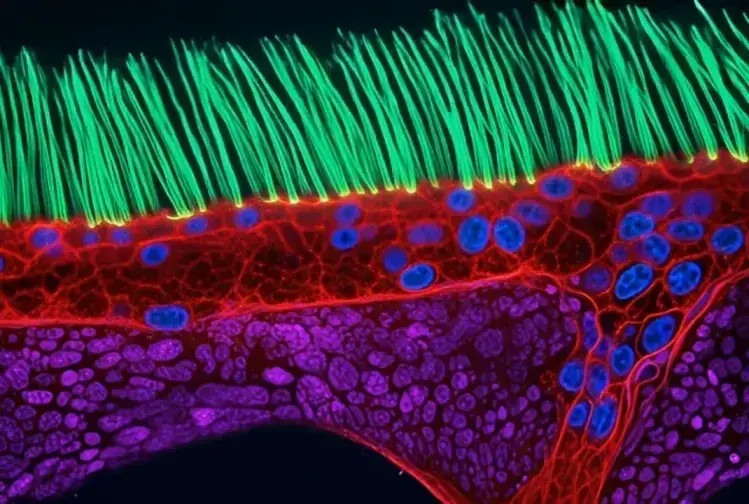 Nikon strips researcher of first place in its Small World in Motion microscopy contest
Nikon stripped a researcher of first place in its Small World in Motion microscopy contest after biologists noticed that microscopic cilia in the winning video were popping in and out of existence.
-
 Neural chip decodes brain networks on 200 microwatts
Most closed-loop brain implants monitor activity in a single area, but psychiatric disorders rarely originate from a single spot.