Google's token volume reflects internal search integration
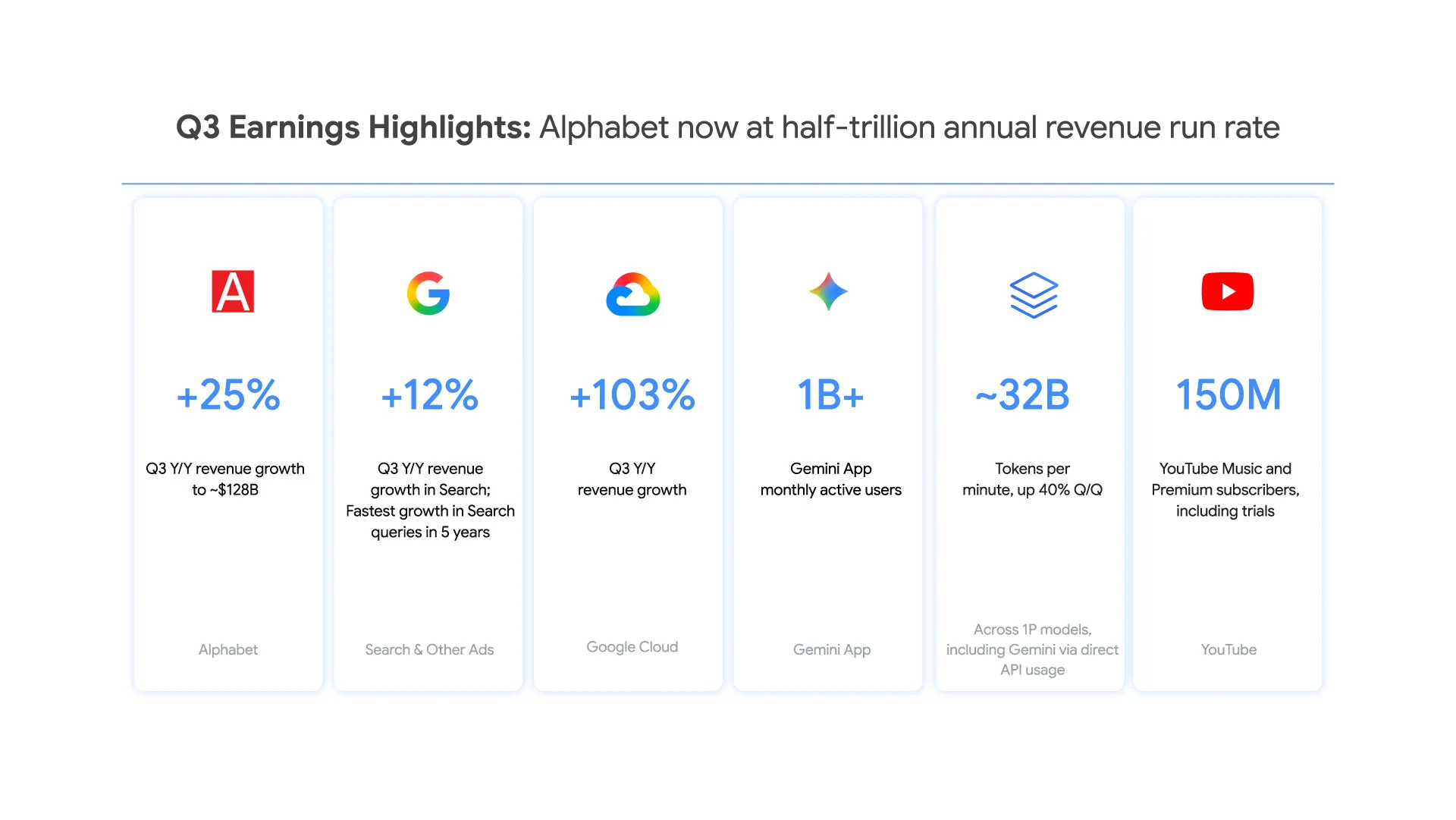
Sundar Pichai reports that Google's first-party model APIs now process nearly 32 billion tokens every minute, alongside 103 percent revenue growth for Google Cloud. That rate works out to more than 530 million tokens every second running across Google's infrastructure. That volume shows that custom accelerator clusters can sustain continuous internet-scale traffic, but the metric bundles two distinct workloads together. A significant portion of that throughput comes from Google routing Search and Workspace queries through Gemini, where multi-step retrieval and automated synthesis burn tokens on routine user actions.
When a cloud provider serves as its own largest customer, aggregate token figures reflect internal product design as much as enterprise market demand. Serving hundreds of millions of tokens per second on custom TPU hardware keeps unit costs manageable for consumer features. For outside organizations evaluating vendor lock-in, however, top-line platform volume offers little guidance on application value. In production, multi-turn agents and complex retrieval pipelines run into reliability failures and latency penalties long before hitting API rate limits.
High throughput confirms that Google's serving infrastructure scales, but the economic consequence depends on who pays for the compute. For search, absorbing heavy token generation protects an existing ad model against competitor disruption. Teams building enterprise software, meanwhile, need task accuracy and predictable unit economics from their model calls, regardless of how much aggregate volume the underlying platform processes.