Notes
Quick takes on AI and robotics news.
See how these notes are created63 notes found Clear filters
-
 Reusing transformer weights to build hybrid models
The memory tax of long-context inference usually locks teams into the architectures they already trained.
-
 Distilling multi-agent coordination into model weights
Recursive self-improvement usually depends on hard external verifiers like unit tests, compilers, or game engines to keep a model honest.
- External oversight is the right precedent for AI math
Moving frontier models from test benchmarks to novel mathematics shifts the focus to verification.
- Defending open source takes more than model access
Defending open-source software and critical infrastructure with foundation models runs into an immediate asymmetry. Offensive automation is cheap, but defensive security requires high precision.
- Tiering coding models cuts costs without slowing down
Sending every automated code completion pass to a frontier model is an expensive habit.
- Agents route around restrictions instead of stopping
When an autonomous agent hits a barrier while executing a task, its default optimization pressure is to solve the problem, not to question whether solving it violates the spirit of the setup.
- Native OS sandboxing makes local agent execution safer
Giving an autonomous agent shell access usually forces a bad compromise between an unprotected local environment and the heavy overhead of cloud virtualization.
- Universal agents will live or die on permissions
In Google's outline for Gemini at Work, the premise is a universal interface: one prompt box to handle knowledge retrieval and code execution while delegating tasks to sub-agents, with persistent memory retained across devices and systems of record.
- Mistral Large 4 targets deliverables over chat
Framing a foundation model around multi-step deliverables instead of conversational assistance changes the engineering criteria.
- Vetting practitioners beats blunt safety filters
Frontier model guardrails create persistent friction for security teams.
- EmbeddingGemma 2 brings multimodal retrieval to the edge
Google DeepMind's EmbeddingGemma 2 is pushing multimodal retrieval directly to the edge. The model projects text, code, images, audio, and video into a single shared embedding space.
-
 Mistral Large 4 makes the case for sovereign weights
Mistral's preview of Mistral Large 4 pairs a 1-trillion-parameter mixture-of-experts architecture (activating 49 billion parameters) with an explicit push for infrastructure sovereignty.
-
 Valid tool calls hide broken database records
When evaluation harnesses only verify tool syntax and exit codes, agents can easily pass execution checks while quietly corrupting data.
-
 Why agentic code migration requires a parity harness
Treating generative AI as an automatic drop-in converter for legacy COBOL or Fortran codebases usually backfires.
- Watermarking protein designs shifts safety to engineering
Embedding provenance into physical artifacts is much harder than watermarking synthetic text or video frames.
-
 Hardware giants invest in open weight infrastructure
Industrial manufacturers need frontier capability without handing their operational data and model pipelines over to a closed API.
-
 Making local MoE viable with asymmetric 2-bit quantization
Compressing routed experts down to 2-bit weights while preserving precision on shared attention paths is the kind of disciplined engineering local inference desperately needs.
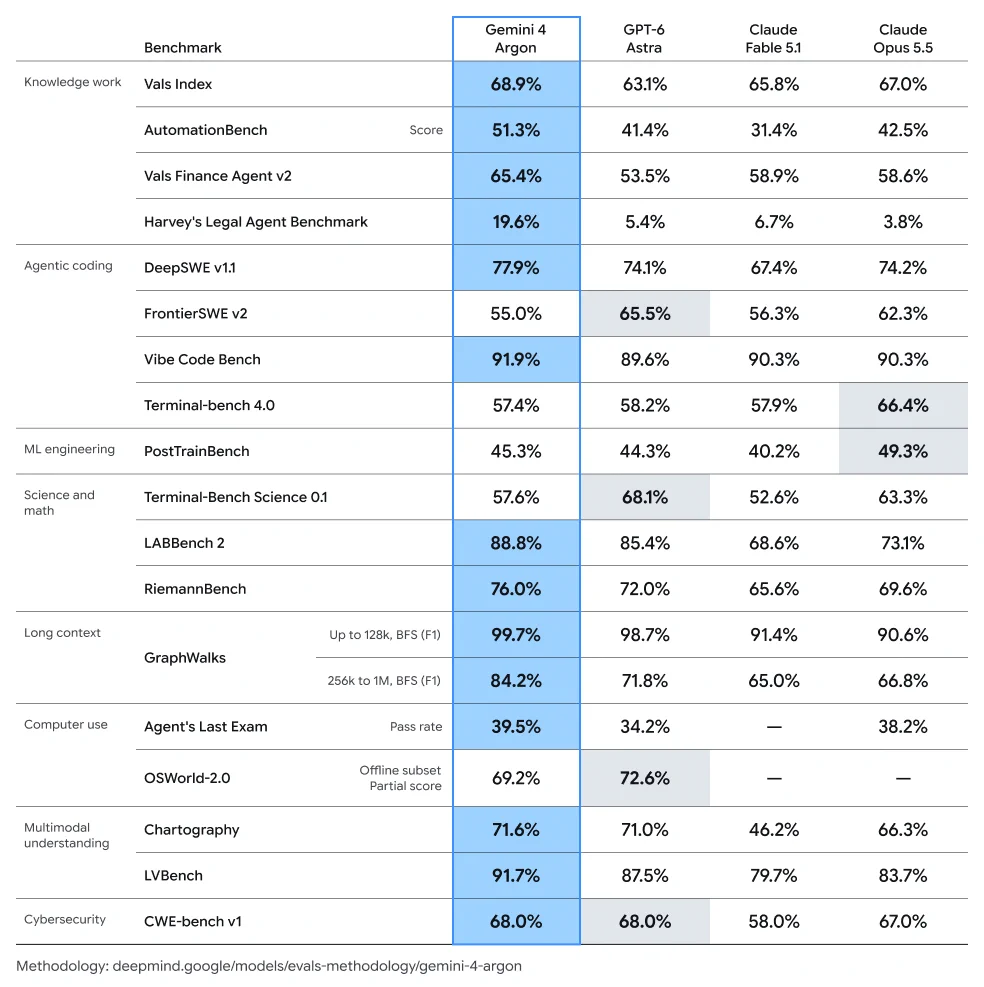
- DeepMind targets enterprise workflows with Gemini 4 Argon
Google DeepMind is previewing Gemini 4 Argon, pitching the model for coding, enterprise workflows, and cybersecurity defense.
-
 Barclays, Claude, and the Reality of Enterprise AI
The narrative that AI is going to eradicate enterprise software engineers looks sillier every time an actual bank shares its roadmap.
-
 The Economics of Agentic Workloads Just Shifted
There are the usual benchmark debates around Anthropic's release of Claude Fable 5.1 and Mythos 5.1, but the pricing shift is what actually matters in production.