Physical AI tackles retail returns on standard cobot arms
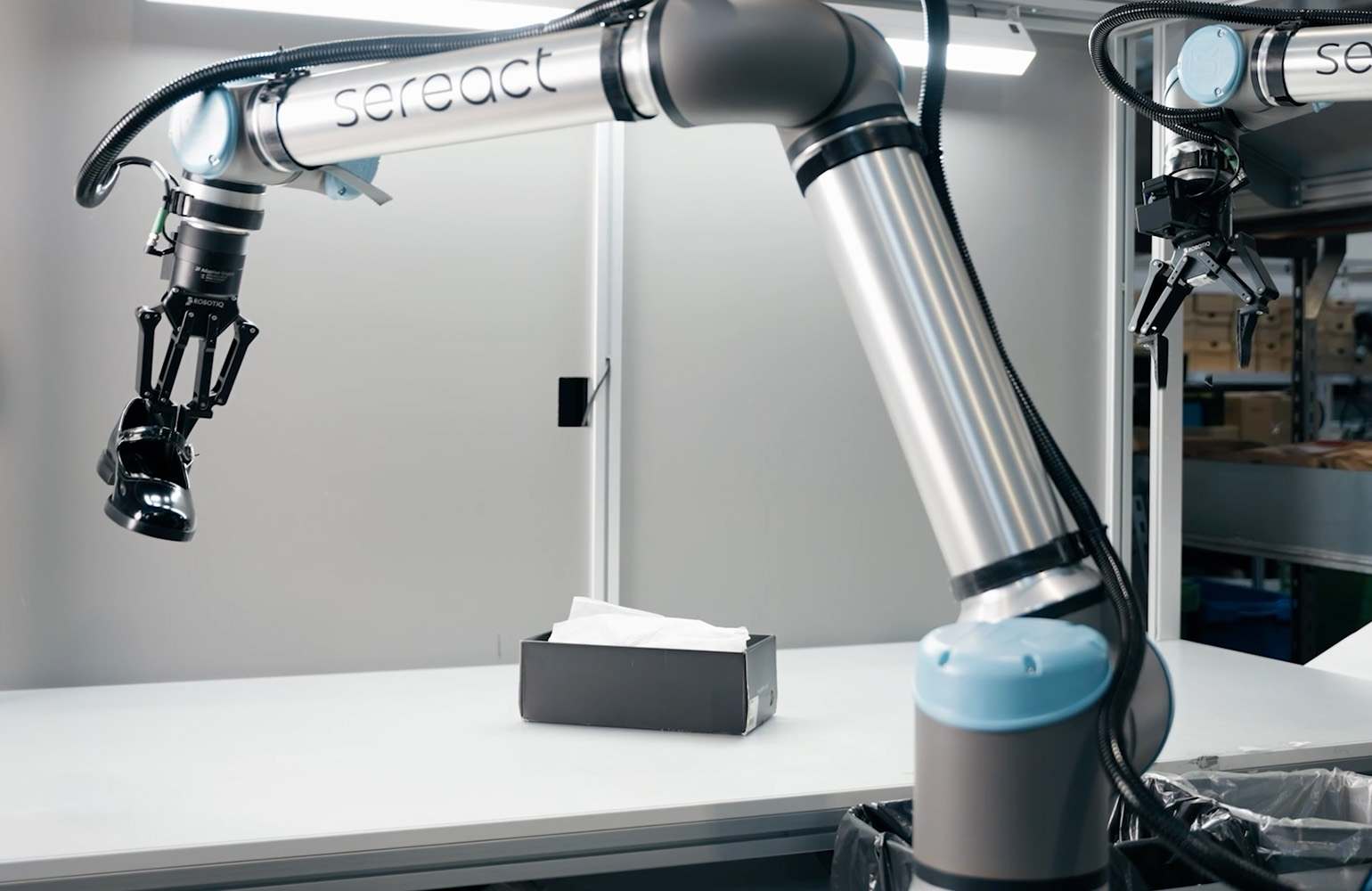
Handling customer returns is one of the messiest operational problems in logistics because items rarely arrive in predictable orientations, shapes, or packaging. The Robot Report reports that Teradyne Robotics and Sereact have deployed hundreds of Universal Robots arms across European facilities to tackle that friction. At Zalando fulfillment centers in Germany and Poland managed by CEVA Logistics, dual-arm cobot stations running Sereact's Cortex platform now autonomously identify, grasp, and sort returned apparel for resale.
The underlying stack shows how physical AI pipelines are consolidating around simulation and edge compute. Sereact trains its foundation model in Isaac Sim using NVIDIA Cosmos world models, handles post-training with reinforcement learning in Isaac Lab, and deploys directly onto Jetson Thor modules at the cell. Running inference locally maintains the cycle times required for line-rate piece picking, while a unified model lets every arm benefit from handling edge cases learned across the fleet without requiring individual retraining per item.
Commercial value in physical AI does not wait for bipedal humanoids or exotic hardware. Standard six-axis industrial arms already have the rigidity and safety certifications required for production lines, provided the perception layer can generalize over unstructured, deformable objects. For retailers managing reverse logistics, European Union rules prohibiting the destruction or landfill disposal of returned apparel turn this kind of automated sorting from an experimental efficiency gain into a direct compliance requirement.